
Engine Flush Extravaganza!
Should you use an engine flush?

We get a lot of questions about engine flushes. Do they work? Should you use one? How do they affect analysis? Your investigative team at Blackstone did some experimenting, and we’ve got answers.
Testing, testing…
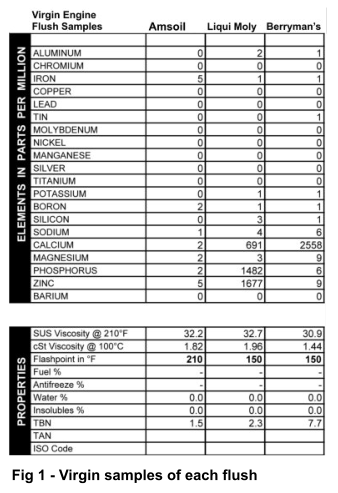
We tested three products: Amsoil Engine and Transmission Flush, Liqui-Moly Pro-Line Engine Flush, and Berryman Oil Change Flush. All three are solvent-type additives, with fairly thin viscosities and low flashpoints. They’re meant to dissolve and disperse sludge, varnish, and deposits. Virgin samples of each flush can be found in Figure 1.
Measuring success
So how would “success” of an engine flush show up in our testing? Oil analysis doesn’t show things like improvements in fuel economy or whether the lifters are quieter, but in theory, if a product is loosening sludge and deposits, there should be something to show for it in the oil, right? Maybe increased insolubles, or higher metals because they’re getting carried out of the engine more easily?
Testing procedure
To do this test, we pulled a sample though the dipstick using a pump, ran the flush according to the flush manufacturer’s directions, then drew another sample through the dipstick post-flush.
Results
For the Toyota Corolla/Liqui Moly combination, the most notable changes are the drop in flashpoint and the slightly lower metal counts (see Figure 2). The drop in flashpoint makes sense. If you have a starting flashpoint of 380°F and you add a product whose flashpoint is just 150°F, the resulting flashpoint is going to be lower. The lower metal counts make sense too. The metals are lower because there’s fresh “something” in the oil. Not oil – in this case it’s engine flush – but the same principle occurs.
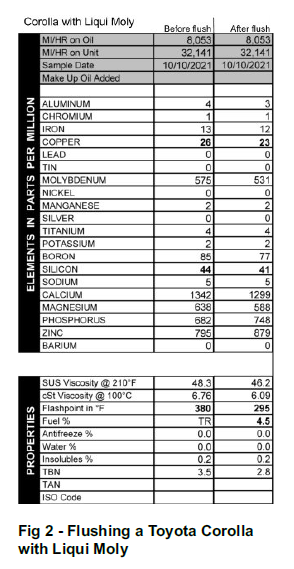
It’s somewhat surprising that insolubles aren’t higher. If the flush is meant to get rid of solids, shouldn’t we see some evidence of that in analysis? But we found no change in insolubles. That doesn’t necessarily mean the flush didn’t work, just that we’re not seeing any evidence of that claim in our testing. Possibly the deposits are getting caught in the filter and removed that way.
An interesting side note on the Liqui-Moly flush in particular, it contained calcium, phosphorus, and zinc in its additive package. You can see the change in those elements in the post-flush sample, with calcium dropping slightly and the other two elements increasing slightly (which makes sense – the initial oil had more calcium and less phosphorus/zinc than the flush had, so adding the flush decreased calcium and increased phosphorus and zinc).The other two engines/flushes showed very similar changes as the Corolla/Liqui-Moly combination: a very mild (if any) drop in metals, no change in the insolubles levels, and significantly lower flashpoints.
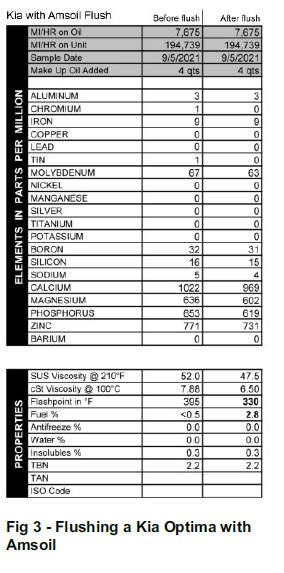
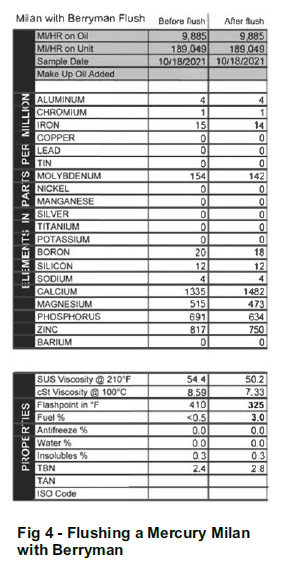
A note on flashpoints: We test for fuel dilution using the flashpoint test. Most unused oils flash around 385 to 415°F. When the test result is lower, that suggests something else is present – in internal combustion engines, that “something else” is usually fuel, so we go on that assumption and calculate fuel dilution accordingly. In this case, the “something else” is the engine flush – not fuel – but they are lowering the flashpoint the same way fuel contamination does.
So do engine flushes work? Our results are inconclusive. Engine flush manufacturers make many claims that we can’t measure in the scope of our testing: decreased blow-by and oil consumption, quieter lifters, improved oil circulation, and reduced emissions, just to name a few. Although we can’t see whether the flushes are removing deposits from the engine, it’s possible they’re getting trapped in the filter and removed that way. In the end, if you want to use a flush, go for it! Just let us know, in case it lowers the flashpoint.
Stay tuned for our next article, where we test different sampling methods, determine the effects of adding fresh oil, and whether it’s okay that oil turns dark so fast. Happy testing!

Related articles

Antifreeze: The Silent Killer
How exactly does antifreeze hurt engines?

The eBay Oils (Part 3)
Part 3 in our series on old oil additive packages

The eBay Oils (Part 2)
Part 2 in our series on oil additive packages from the old days

The eBay Oils (Part 1)
What kind additives did oil have back in the old days?