
Evans Waterless Coolant in the Oil
A customer asked if we can see Evans Waterless coolant in oil analysis, so we decided to experiment.
I started drinking coffee at the age of 12. It wasn’t a question of “if” but “when,” considering my dad is a coffee drinker and I was already busy adopting everything from his sports teams to the music he played, so there was no sales pitch needed from Big Bean or anyone else to lure me in to trying a cup. If I was going to commit, though, I’d need to drink coffee black, just like dad. Not even a whiff of half-and-half was to be anywhere near the morning mug, and he didn’t go looking for sugar either, unless it was in the form of an iced chocolate cake from Tom’s Donuts down the street.
Eventually, I reckoned that while Dad’s example was a firm foundation in many ways, at the end of the day I had to brew my own code of conduct, if you will, from the ground up. For me, that calls for the addition of one, just one, Sweet’N Low per cup. One packet contains the ideal serving per cup: 1 gram of that classic saccharin blend that contributes a sweetness that, in my opinion, complements and doesn’t overpower the blend you’re pouring up.
Whether you’re adding cream or sugar, though, the desired effect doesn’t occur unless you effectively combine the two. Usually that’s a few stirs with a spoon before taking your first sip. Years later, I realized that there’s a lesson to be learned here that applies not just to the mug-handed, but to your favorite oil analysis laboratory, too.
Enter Evan
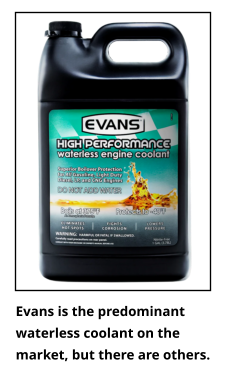
Fast forward about two decades, and I was sitting behind the keys at my desk on the Blackstone campus, no doubt armed with my custom medium roast and Sweent’N Low blend. I checked my email to find an inquiry from one of our Slick Talk listeners, who asked if we could detect the presence of Evans High Performance Waterless Coolant in oil. Given that Evans Waterless is a glycol-based product, I didn’t have any doubt that we could see it at potassium and sodium, which are the elements we use to find coolant in the spectral exam.
The “waterless” aspect wasn’t an obstacle, since it’s common for there not to be any water left in oil that’s riddled with coolant — when the engine reaches operating temp, any moisture evaporates. Still, the potassium and sodium that are introduced to the oil with coolant contamination should remain long after the water is gone.
Mixing Oil & Coolant
When you work for a lab, though, there’s no need to rely on assumptions when we can use data to know for sure. It’s not hard to scrounge up oil around these parts — I just needed to procure some Evans Waterless to mix it with.
While I was pretty sure I’d see the contaminant, I wasn’t sure what amount of Evans might register. I chose three amounts: a drop from a pipette (0.04% of the sample volume), a full pipette’s worth (5.61% of the sample volume), and then a little more than a ¼ of the sample being coolant (28.9% of the sample volume). Then we ran them through the spectrometer.
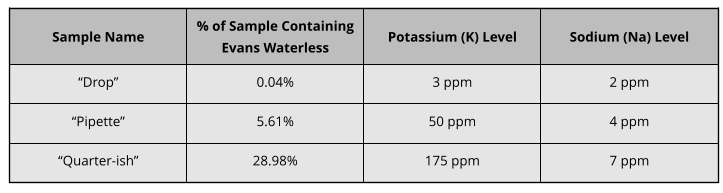
It turns out that a drop of coolant in the oil didn’t register in any significant manner, and that’s fitting — I wouldn’t expect a few specks of sweetener to stand out in a cup of coffee either. The pipette sample had enough potassium to show evidence of coolant, so it makes sense that the “quarter-ish” sample size of coolant was even easier to spot.
Still, I knew something was wrong about this process. For a thorough evaluation, we needed to do a better job of replicating the way coolant contamination shows up in testing.
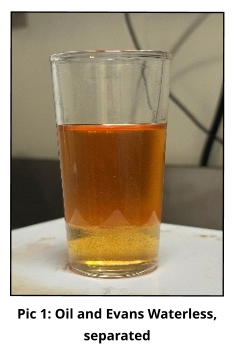
Usually, when we’re looking for coolant in the oil, the glycol-based contaminant has been so thoroughly combined with the oil that we often won’t see a visible separation of oil/water. This process takes place as the oil heats and circulates, which you can’t really replicate just by adding coolant and the oil to a bottle and shaking them up — there remains a visible separation between the two (see Pic 1).
Take Two
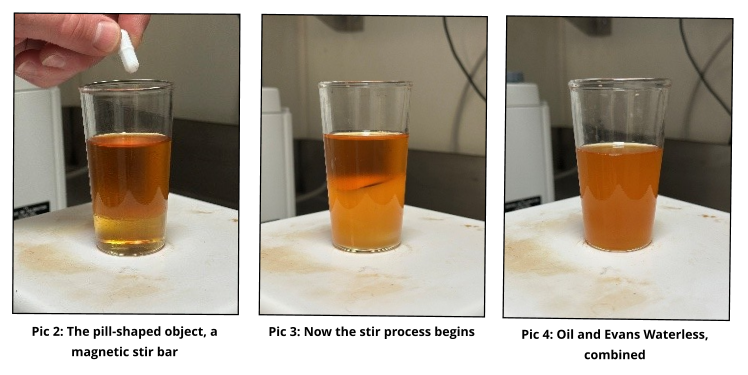
A full-flavored cup, er, experiment would do for the oil and coolant what the spoon does for combining Sweet’N Low and coffee. The next step was to heat our samples and stir to combine. We used a stirring hot plate, on which we placed a beaker containing oil and Evans Waterless, and a steel stir bar in the beaker, which spins as the surface heats (see Pics 2—3). The more coolant that was present in each sample, the longer it would take for the two to combine, but combine they did, and then we had samples fit for the palate of a spectrometer (see Pic 4).
While a drop of coolant still didn’t lend much in the way of meaningful data, the presence of Evans Waterless was loud and clear in the samples containing a pipette’s worth, or more, of the coolant.
The Last Drop
So now we know: whether you’re running Evans Waterless or not, the elements that show coolant do appear in the spectral data. We see it in the form of potassium and sodium, just like we would any other glycol-based coolant.
You may be wondering: how much potassium or sodium before we can assume a problem? Let’s go back to our reference samples after mixing: a drop doesn’t really give us enough potassium and sodium to assume a problem, but even a pipette’s worth of Evans Waterless contributed >400 ppm of potassium. And we’d consider 20 ppm of that element enough to signal contamination. Sodium, on the other hand, wasn’t as prevalent in Evans Waterless, which is why it’s nice to have more than one coolant marker to rely on.
In the end, we may take our coffee differently, but we can all agree that coolant has no place in the oil, and testing tells whether it’s present: water or no.

Related articles


Landslide!
What size metals can we see? Think of a landslide

Do You Need ZDDP?
An experiment to see if a lack of ZDDP will destroy an older, flat-tappet engine

What’s the Best Kind of Oil?
The Answer May Surprise You!

TBN/TAN: Do You Need One?
It depends on your goals!