



Normal vs. Abnormal Results
How can we tell if something’s not right? We compare to averages and compare to the trends you’ve established.
For example, we do a lot of BMW M3 samples from owners who are concerned about bearing wear. Below are side-by-side samples of a normal M3 and one with poor bearing wear.
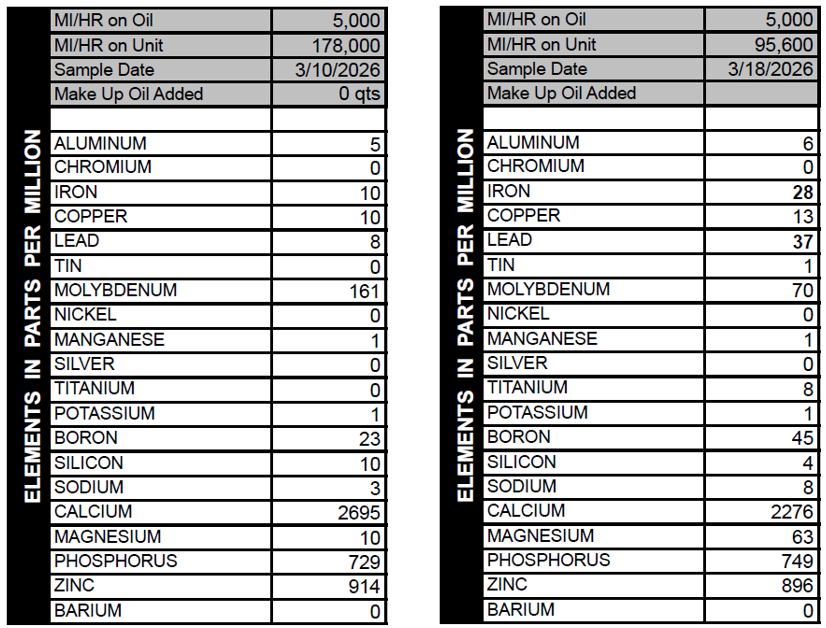
Both are 2003 M3’s with the S54 engine. Both have 5,000 miles on the oil, and both are running 10W/60 oil. Lead is just 8 ppm in the sample on the left, and 37 ppm in the one on the right. The engine on the right is suffering from poor bearing wear.
We have averages for most types of systems, and even if we’re seeing something new, we probably have a pretty good idea of how it should be wearing. We take into account things like shorter or longer oil changes, hard use, inactivity, contamination, make-up oil, and the zillion other factors you tell us about. Sometimes we’re stumped about whether something’s out of line…but usually we’re not.

Blackstone vs. Artificial Intelligence
Late one afternoon about a month ago, one of our analysts pulled up a report on a guy’s 2022 Tundra. On the oil slip, the customer mentioned that he was sharing his Blackstone report in one of his YouTube videos — which we generally really like since it gets our name out there. But then we watched the video. He had fed our report through AI…and AI got it wrong. The chatbot had incorrectly analyzed our test results.
We were able to reach out to the client and explain what was wrong, and they added the correction to their video. But what about the other cases out there, where someone uses AI to get a second opinion of their results? Well, as you can imagine, AI can be useful, but it’s not always right: It can overlook problems and cause anxiety over results that don’t warrant it.
AI’s answers — where do they come from?
AI chatbots like ChatGPT and Claude are “generative aritificial intelligence,” which (as we understand it) takes all the data it can get from the internet or wherever else to generate answers, responses, or even pictures and videos to whatever prompt you enter, no matter if the data is right or wrong, old or new.
That’s fine in some applications, but when it comes to oil analysis, you’re better off going straight to the source: our analysts, who have been looking at oil samples from engines, transmissions, gear boxes, etc. for years. We train our analysts using knowledge from engineers, people in the oil-blending business, and our clients — institutional knowledge that’s been growing since 1985.
What can AI get wrong?
For one, the wear metals. In the video we mentioned, AI told the client that copper, lead, and tin are bearing metals in their new Tundra’s engine, but that’s wrong: that engine has aluminum bearings. Of course, sometimes AI gets it right, too, so we decided to test ChatGPT ourselves, using results that could look concerning to the untrained eye.
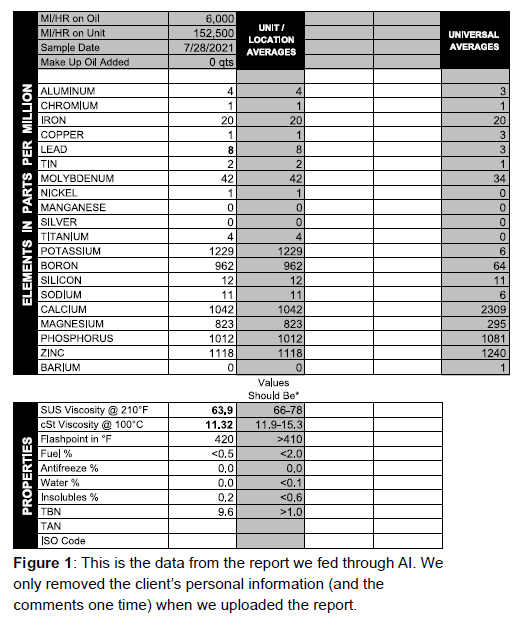
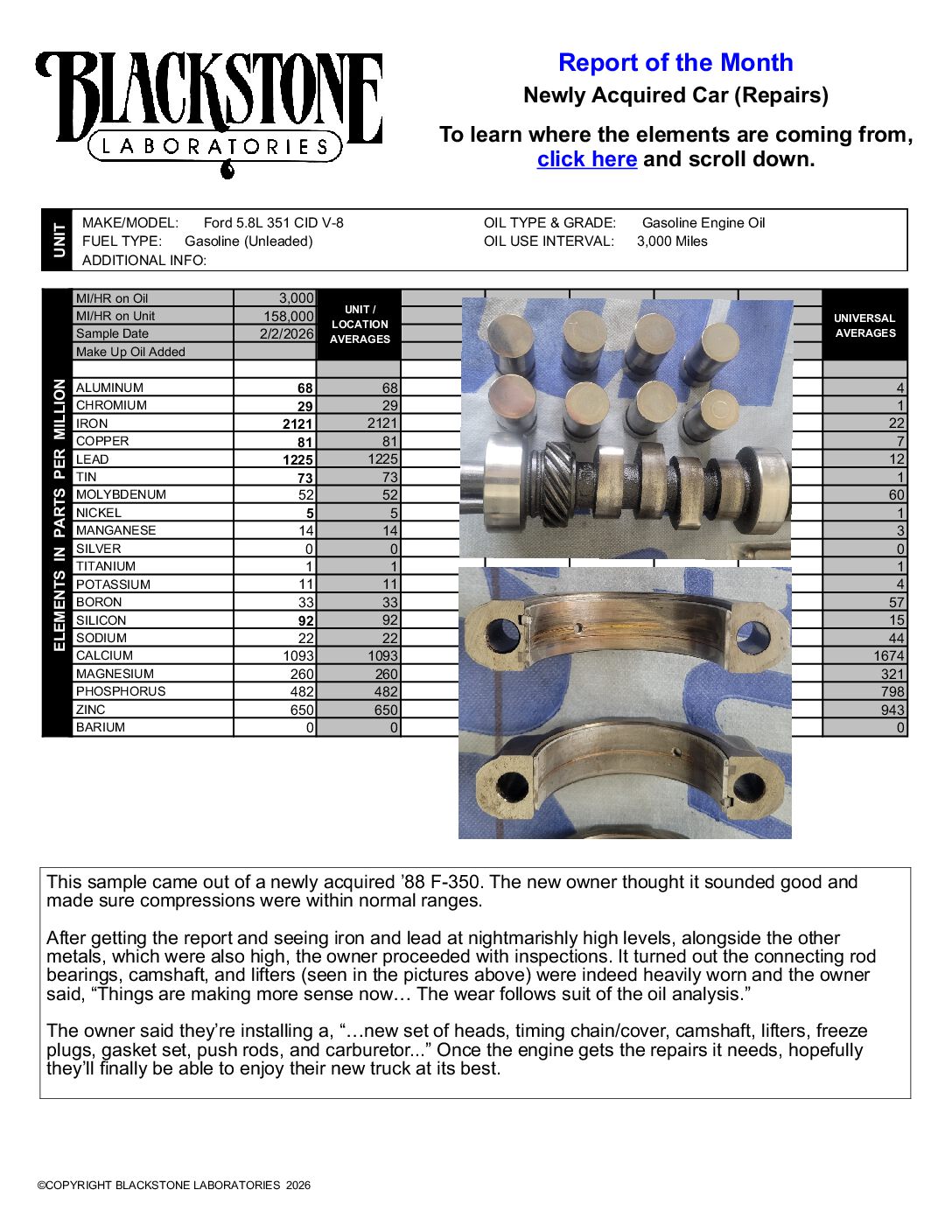
Figure 1 shows the results from a 6.0L Power Stroke engine. Lead is the only wear metal in bold, and it indicates some extra bearing wear. We didn’t make a big deal of that in the comments, but we did suggest they watch for low oil pressure as a precaution. Potassium was pretty high in this sample, but we didn’t call coolant contamination since they noted Archoil AR9100 additive was used, which has a lot of potassium and boron in it; and the other coolant marker (sodium) was also low. In our comments, we called this a pretty good report overall, and lead was the only thing to check back on.
AI with our comments
Then we uploaded the report to ChatGPT, both with and without our comments. We found that AI did a pretty good job summarizing the results when the comments were included (see Figure 2).
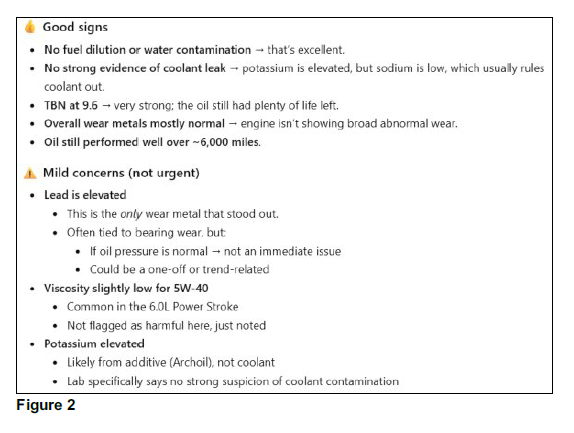
We disagree with listing potassium under the “Mild concerns” heading, but other than that, it looks pretty good — though note that it referenced our comments in its summary.
AI without our comments
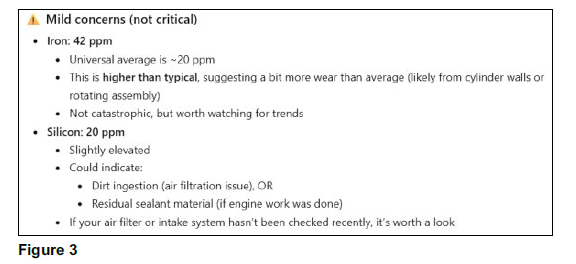
Without our comments, AI’s interpretation of the report was a completely different story: AI didn’t read the data correctly. It said iron was at 42 ppm and silicon was at 20 ppm (see Figure 3).
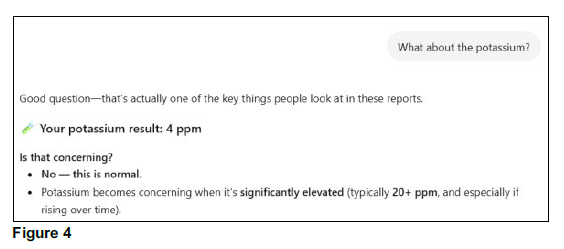
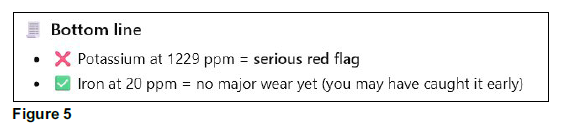
It also incorrectly read the potassium result when we asked about it (see Figure 4). After we corrected it, it did call the iron reading normal but it still interpreted the potassium incorrectly and called it a “serious red flag” (see Figure 5). And after we asked it if using Archoil additive affected anything, it said “it does NOT contain potassium as a meaningful component,” which is just wrong.
We’ve also seen cases where AI was unnecessarily alarmist, telling one BMW owner his bearings were “screaming” when only one metal was mildly out of line. It seems to be hard for AI to give a person good context or an answer to, “How worried do I need to be about this?” That understanding — having a clear idea of how much of a problem something might be — is something that only comes with time and experience, from evaluating hundreds of thousands of samples, talking with customers, and putting the results into context given the circumstances surrounding the sample, the engine’s history, and how it’s used.
The human element
Of course, humans aren’t perfect either. But we have been doing this for decades now. Even with new engines and new types of oil coming out all the time, we here at Blackstone generally have a pretty good idea of when something looks like a problem or not.
At Blackstone, there are humans behind everything we do. You will always get a live person when you call, and we’re happy to have you speak with the analyst who wrote your report. Our analysts are looking at your report, analyzing the data, and thinking about what the numbers mean in the context of what you’ve told us about the engine and its history. We will go over your results with you, answer any questions you may have, talk about the reasons for unusual readings, and make suggestions. AI might be fun to play around with, but if you want solid, factual information, it’s better to go straight to the source and rely on our comments or call/email us with questions. You can rely on Blackstone Labs: the humans behind the analysis.

Rebuilding a GM 350 Engine
This is a story of my first complete rebuilding an engine. The engine is a GM 350 V-8 out of a 1984 Chevy Custom Deluxe pickup truck. The truck was custom in that I’m fairly sure no other truck is rusted in exactly the same way, and deluxe in that both windows still roll down.
I purchased this truck in 1999, and one of the sales points of the truck was the engine. It started up and ran well, though it had a super high idle that did not want to drop down after the engine warmed up. The vehicle doesn’t have an RPM gauge so I can’t say exactly how high it was, though it was so fast that I did not need to step on the accelerator after a stop light and it would get up to about 35 MPH on its own. I figured this was a carburetor problem and could be addressed later.
I was in love with the truck and had to have it. I didn’t even bother to do an oil analysis on it before I bought it, partly because I felt I could fix anything that went wrong and partly because I was scared at what I would find.
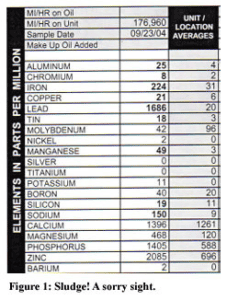
After pulling the first sample, I was glad I hadn’t seen it before I bought it. This engine had clearly been used and abused, which was to be expected for a former work truck with over 160,000 miles on it. (See Report #1 B30210.) I felt that if I changed oil several times over the next few thousand miles, I would be able to clean the engine up and hopefully get another 100,000 miles out of it.
This truck was not my daily driver, so the high idle problem and poor wear weren’t too big of a concern. After about two years, I pulled the original carburetor and had it rebuilt by a shop. This seemed to help for about 500 miles, and but then the high idle came back. I was also finding a lot of fuel dilution in the oil. I attributed the idle and fuel to a poor rebuild of the carburetor and my fix was to curse the guy who did the work. This didn’t help the problem, though the truck always started when I needed it, so I didn’t feel the need to try and fix it again.
Smoke on start-up
Eventually the day came when I started seeing some smoke on start-up. At first it wasn’t too bad, just a little for about a minute, but then it stared getting worse — bad enough that the smoke killed all of the mosquitoes in a two-block radius. I was told that replacing the valve seals should fix this, so I decided to take the truck out to my Dad’s barn in Ossian and tear into it.
Ossian is a little town abut 15 miles south of Fort Wayne, and among its many charms is its zip code: 46777. Maybe their town slogan should be “Get Lucky in Ossian!” Or maybe not. Anyway, Dad’s barn wasn’t the best place for engine work, mostly because it didn’t have any doors, had a dirt floor, poor lighting, and birds lived everywhere, but it was better than working on the street.
I dug into the engine hoping that I would just be able to remove the heads, get them cleaned up, replace the carburetor and we’d be back on the road. Unfortunately, when I removed the valve covers, that’s when I ran into my first problem: sludge! Not just a little hidden in the nooks and crannies of the head, but large chunks the size of a golf ball. (See figure 1 and C27858.) This was my first sign that the engine might need a little more love than I have figured on.
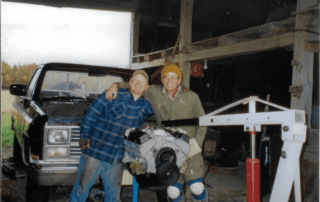
After removing the oil pan and finding some scored bearings, I decided to pull the whole engine and do a complete rebuild. So I borrowed an engine puller, got the engine loose, and hooked up the chains, and ran that’s when I ran into my second problem. The puller I borrowed was made for a car and I could not clear the radiator, even after jacking up the puller as far as it would go.
Removing the engine
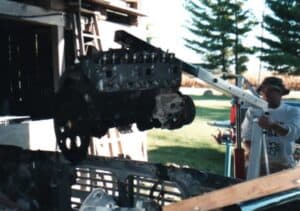
To get the engine out, we had to lower it onto some wood blocks and hook one removable chain link from the puller arm to the webbing between the holds of the carburetor intake. This was a dicey maneuver to say the least, but it worked. I was originally thinking about swapping out the steel intake manifold for an aluminum one, but after seeing the strength of the original steel one, I was too impressed to scrap it.
Once we got the engine out, I commenced to pull it apart. I got the major parts cleaned, replaced the bearings, painted it up nice, and put it all back together. It took about a month and it was late October, but I finally had it all back together and looking pretty.
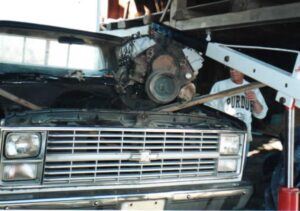
I used the same method to get the engine back into the truck. All the necessary parts went back on and I eventually got to the point at which I was ready to start it up. At the much-anticipated turning of the key, I ran into the third problem: nothing happened. Sure, the starter was trying to turn the engine over, but the engine itself was locked up solid. After some discussion, we decided I may have mixed up the order of the rod-end caps, and this acted like a clamp around the crankshaft and prevented it from turning. In hindsight, I guess I should have realized something was wrong when the engine was out and it took a crowbar on the flywheel to make it turn so I could adjust the valves, but hey, that’s hindsight, and I was a rookie.
Well, it being late October in Northern Indiana in an open barn with no heat, I didn’t really look forward to the prospect of pulling the engine out again, doing another rebuild, and then putting it all back together. Fortunately, we had just bought a new building for Blackstone to move into. It was a construction building in its previous life that had a nice big garage, a chain hoist, and a heated workshop. So we loaded the Custom Deluxe onto a flatbed and had it taken to the new building.
After a few months of off-and-on work, I had the engine back in place and ready to start up. This time it cranked over just fine and eventually started with some timing adjustments and only a little eyebrow hair burned off during a backfire.
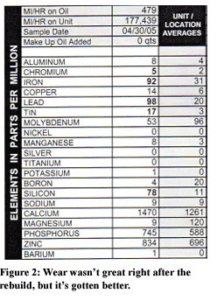
The first few oil reports weren’t pretty, but it’s been 8,000 miles and five years since the rebuild and I’m happy to say it’s still running well. It’s still not wearing as well as I would like, but the truck doesn’t see a lot of use, so I blame that on corrosion due to inactivity. The fuel dilution is pretty much gone and I don’t get any smoke on start-up, so all in all it was a successful job.
Now that the engine is pretty much past wear-in, I’ve decided to start experimenting with it. There has been a lot of talk lately about the importance of zinc in an engine. All gasoline engines oils have an additive called zinc dithiophosphate. It’s an anti-wear additive and is normally present at a level between 500 ppm and 1,000 ppm. Apparently, newer gasoline engine oils are dropping their zinc level and this is causing cam failures in flat-tappet engines. Being a bit of a skeptic, I’m not sure this is the case, so I’ve decided to use my freshly overhauled flat-tappet GM 350 as a test bed. Stay tuned for the next newsletter as I try running Aeroshell W65 in it — an oil that doesn’t have any zinc additive it in at all.
I’d like to thank Jim Stark (my Dad) for letting me use his barn and all the help he gave me during the process. Also C&P Machine shop for letting me know which rod end cap went to which rod (very important). And also my wife, for not throwing me out during this project.


On Towing
A harrowing tale
It was a late and dark night in the California mountains. Our 36-foot, hinged-in-the-middle rig was straddled in a sharp “V” across a two-lane mountain highway, with no obvious way to get unstraddled. Behind us was a vertical rise in the terrain going straight up, in front of us a sheer drop off that appeared to be a black abyss. Up and down the highway the pavement curved to invisibility. We were sitting ducks for any unsuspecting semis that may have been motoring innocently along the route at highway speeds. I could imagine our stranded rig suddenly coming into view of a trucker who knew in a flash his goose was cooked: He could shoot off the cliff or T-bone us. It would be a spectacular crash.
How we got in this predicament is embarrassing. It was the fourth consecutive driving error on my part and it could have been my last. My truck was not ideal for towing: I had the off-road package, not the towing package. Gas stops in the California mountains are infrequent, making it nearly impossible to drive on the bottom half of the tank. We had planned to arrive on the west coast at 6:30 pm. But we needed gas, and no gas was available in the foreseeable future, so we had to turn around. We’d passed a Shell station 35 miles back and the only solution was to drive back and fill the tank.
We were quite tired by this point, and frustration was setting in. The drive back was up and down steep grades. When the station finally came into view we were coming down a steep grade and we saw the station on the right. What we missed was, the road curved sharply to the right and the station was actually on the left. This is important, as you’ll see.
After filling up, I ran over a tall curb getting back to the road. It wasn’t a huge problem, but the camper doesn’t have much ground clearance and the scraping noise was painful. I turned left to finish our drive to the coast. Kathy dozed in the right seat.
Maybe 45 minutes later, I started wondering where all the hilly terrain was that we had driven over getting back to the gas station. I woke Kathy and asked her to turn on the GPS. You can probably see where this is going, right? We were headed east, not west! The frustration level immediately increased to a silent roar inside my head.
I needed to turn around (again) but there were precious few places to do so. I finally found a wide spot in the pavement, just wide enough you could pull a car clear of the road. I pulled as close to the side of the mountain as I could and swung a hard left to make the u-turn. As we neared the far shoulder Kathy screamed, “STOP!” I raised up off my seat for a look and our right tire was about to drop off the side of the cliff, into the blackness.
What to do? I was already jack-knifed. I didn’t know if I could gain anything in reverse but I sure couldn’t go any further forward. After a moment’s consideration, I cranked hard right in reverse and forced the jack-knife as tight as I could without breaking anything. I cranked hard left, shifted to 1st gear and popped the clutch. I’ll never know if that right front tire caught air or not, but we didn’t drop off the cliff.
We finally made our destination at 11:30 that night. We had to stop at the Shell station a second time to assure we would make it. All the rest of the drive I was thinking, don’t make a fifth error. It will surely be the end!
The trailer
We were pulling new camping trailer we had bought the week before we left. I had no experience towing loads other than incidental occasions in my 50-plus years of driving. A couple times unreasonable trailer loads had nearly overwhelmed whatever vehicle I had been driving at the time. This was experience I didn’t want to repeat.
We had been planning to drive to the west coast for some time, but only at the last moment did we realize we had the funds to buy a camper. Kathy used to own a trailer that she pulled with a half-ton pick-up. It was an older unit and heavier than what we eventually bought, a 16-foot unit that weighs just short of 3,000 pounds empty.
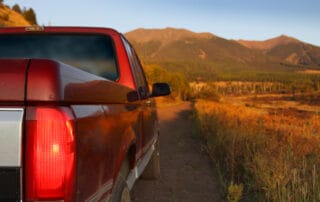
I drive a Toyota Tacoma and until I actually studied the owner’s manual about weights and capabilities (well into our towing trip), I had no idea the limits of my truck. I made the trailer purchase based on hitch weight, a number I looked up as we were talking to the camper salesman. He said we could pull this unit and I was little less than shocked to find he was right. The hitch weight of the trailer we were looking at was about 50 pounds less than the Toyota book suggested I could put on the hitch. With that fact alone, we went ahead and bought the trailer. The salesman said: “You won’t even know the trailer is on there!” How many times have you heard something like that?
The experiment
I wanted to leave my old oil in the crankcase to demonstrate how abrasive, used oil can affect the bearings when you work an engine hard. Toyota engines don’t make much metal under any circumstances, and for the near 100,000-miles I have driven this truck, I’ve never seen as much as 1 ppm lead in the oil from the bearings. Typically I change oil every 9,000 miles. Most of my driving is easy: country roads at moderate speeds, only rarely hauling anything, though I don’t hesitate to bump redline often…like nearly every time I drive. Don’t ask why. I’m out in the country and I just like the feel of the engine as it accelerates past 5,000 rpm. I’ve always contended that driving an engine hard doesn‘t hurt anything so long as you stay within redline. I’m still of that opinion.
Anyway, for this trip, I wanted to demonstrate that you can get poor bearing wear if you work an engine hard with dirty oil in it. I had more than 5,000 miles on the oil when I bought the trailer. Miles on the oil were accumulating fast and I still hadn’t left. I knew the next drive was going to be more than 6,000 miles…and at the last minute I chickened out. I could imagine the oil was going to be running warmer than usual and at 11,000 miles or so, the 5W/30 oil could turn to sludge and I’d puke the engine. I’d never live that down.
So I changed oil at the last minute and also had the rear differential and transmission serviced since I knew those gearboxes would run warmer as well. When I got back from the drive I knew I would have a nice apples-to-apples oil analysis comparison for the engine: the first analysis showing routine wear under no-load driving, the second I assumed would show much higher wear after abusing the engine to the extreme with a heavy load in mountains and across deserts.
Get up & go!
Kathy had a week to load the camper. I realized I had no idea how much weight she was putting into it. I thought momentarily about driving to a local stone quarry and having it weighed. That thought didn’t take root. Life is a gamble, right? Start to finish. In the end I loaded up a full row of firewood in the front of the truck bed, threw in the heavy cooler, hooked up and towed the load into a cold, gloomy, late October evening.
The first leg was 100 miles due south. There was a nasty, gusting crosswind from the west and it had me talking to myself for a couple of hours. I was sincerely wishing for another 50 horsepower and a heavier truck. Then we turned due west into the wind and things started settling down. I had Kathy drive to tell me how it felt compared to her half-ton pulling her old camper. She liked the feel of it. My heart rate was trying vainly to return to normal and her opinion helped a lot. Being married to an excellent driver is a blessing I hope you enjoy. I even started getting some honest hope that the next 6,000 miles wasn’t going to be a nightmare.
We crossed the fields and plains and wove our way into the mountains. The driving got easier. I never did get to the point the trailer salesman suggested (“You’ll never know it’s there!”) but mile after mile, the tension eased and we started having fun. We made Las Vegas a day early even though the normal approaches to the Hoover Dam were closed, causing long detours. We parked at an RV park just on the south side of Vegas proper and at the appointed hour, enjoyed talking about Blackstone to a large group of RVers.
Mountain driving got serious after we toured Death Valley and headed west across California. The climb out of Death Valley was memorable. From 282 feet below sea level to about 7,000 feet above in a very short stretch of road, we did our hardest climbing. Twice the steep grade got me down to second gear. That’s second gear on an Interstate highway and no one else was doing much better.
All this hard climbing, and all through the trip the coolant temperature didn’t vary at all. It just sat there like the needle was painted on. I’ve had normal cars overheat climbing up places like Pike’s Peak, just plain old cars with hardly any load in them. Here’s my Tacoma (we started calling it Taco-Ma) leaving Death Valley pulling 3,000 pounds of trailer and all the stuff Kathy packed in it along with a heavy cooler and a full row of firewood, and we got no variation in water temperature. I’m more than impressed. I’m amazed!
Gas mileage, however, was terrible. Normally Taco-Ma averages about 22 mpg on the highway. For the total trip, we averaged 12.6 mpg. There are long stretches of highway in the west where you can’t find gas. We had one “white-knuckle” drive that left us with less than a half-gallon by the time we found a station. After that, we started carrying four gallons in the bed of the truck.
Drive it like a bug
Towing the trailer reminded me of driving the original, underpowered VW Bugs. They could run about 70 mph on the flat, full-out. If you wanted to not slip too slow on the next upgrade, you held the petal to the metal on the downgrade and held it there, using momentum keep the speed from decaying. The end result is you keep the petal planted hard for most all hilly driving. Watch redline like a hawk. Shift when you must. Don’t let RPM sag too low. Driving like this, no wonder we lost ten mpg on this trip.
The drive took us to southern California for a couple of days, then back into Nevada and on down to Tucson for a couple more days. We crossed New Mexico, entered Texas down near El Paso where immigration problems are evident. We passed through a check station and as we approached we passed by a dozen sensors of some type staring us in the face, like so many cameras of a sort in a bank of equipment. They can apparently see through cars, trucks, and campers because they let us pass without much thought. There were no stowaways aboard.
We drove Texas diagonally ending up at Texarkana. You can drive 80 mph in southwest Texas. We didn’t. Could have, I suppose, though by that stage of the trip, I’d had enough of pushing the engine.
When Taco-Ma’s V-6 shoulders into a hard, long pull (which was invariably accompanied by Kathy and I shouting in unison, “Go Taco-Ma, go!”) you hear a sound of seriousness. The engine is an airpump. When you work it as hard as you can, throttle mashed to the floor, mile after mile, the serious roar is the scream of air intaking, passing through the core of the engine, and the jetting out of exhaust. It’s a heavy growl, an awesome sound. I’d heard it enough by the third week. And by then I was thinking seriously we might get home with no serious problems. The day-long drive across Texas was made about as cautiously as I could make it.
From the barren plains of Texas to the beauty of Arkansas was dramatic. Arkansas comparatively, looked like the Garden of Eden; like less populated parts of Wisconsin or Michigan. It also felt like we were closing in on home. Mountains and deserts behind us. Now just stay awake and drive.
We finally got to use the firewood in Tennessee. We burned it all in one night and what I learned was, the extra weight in the bed had been a nice asset. We had played with weights and balances daily for the trip, trying to find the magic balance for perfect handling. Turns out, using the firewood made the most difference of anything we’d tried. Less weight all around and almost none in the truck bed left the unit squirrelier than for any other trip leg.
The moment of truth
As soon as we got back I had the engine oil changed, along with any other gearboxes I hadn’t already changed out earlier. A day later my emailed report arrived. To my amazement and delight, engine wear hadn’t changed at all! Not a bit! The extra 1 ppm iron that turned up is from the longer oil change (6,672 miles vs. only 5,175 miles for the pre-trip sample). Iron tends to accumulate with more miles on the oil.
I was wrong in my assumption that towing and mountain driving would cause excessive wear. In large part I think this can be chalked up to the engine type. Perhaps it would have turned out differently had I been using old oil; the metals could have conceivably accumulated to levels that would have made the oil abrasive, which will cause excessive wear. But with clean oil, I didn’t find any change at all. Taco-Ma did us up right.
So will the same thing happen for you? If you run autocrosses or run at a drag strip or do anything other than ordinary driving, does your engine wear change as engine stress increases? Sometimes it does, but in the end there’s no hard and fast rule. So much depends on the engine, the driver, and the environment.
That’s why it’s no good to say all engines should have an oil change at 3,000 miles or 5,000 miles or beyond. The oil and engine combination that works for one guy may not work for the next, simply because all situations are different. It seems logical that if you don’t keep clean oil in the sump when loading the engine heavily, you will wear more at bearings. But if you run clean oil? Maybe no change. Try it and see.
Aircraft Problems: Should I Be Worried?
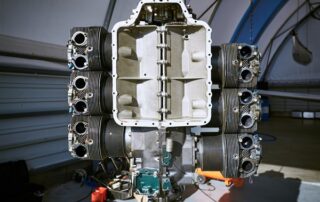
One of the main purposes of oil analysis it to find problems that might be developing in an engine, and after doing this for a lot of years, I can say without a doubt that it works. However, some problems are more urgent than others, and part of our job is to determine if a problem is a major one or not. Most engine problems start out minor but if left unchecked can lead to major issues, which eventually result in an engine’s demise.
Minor problems
Abrasive Contamination
Dirt getting past the air filter will cause a lot of problems in an engine, and piston scuffing is the primary concern. Fortunately, most air filters do a really good job even when they are dirty. If you change your air filter on a regular basis, then this type of problem is pretty easy to avoid, but remember, it’s also important to check the whole air induction system down-stream of the air filter to make sure no cracks or other problems exist that could be letting dirt in.
Fuel dilution
This generally includes any fuel level between 1.0% and 3.0% that keeps showing up again and again. This is not a normal situation, but it doesn’t necessarily cause an engine problems in the short term. Still, since fuel is a contaminant, it will cause the oil to oxidize faster that it normally would. That typically causes problems like stuck oil control rings, which leads us to our next minor issue.
Oil Consumption
This one isn’t really a problem at low levels because all engines are designed to use some oil. What you really want to watch out for is a change in how much oil is being burned. If you always use 1 quart every 10 hours and it suddenly jumps to 1 quart every 3 hours, then you know something has changed. That’s part of the reason we ask about oil added between changes. If you’re not losing oil due to a leak, it’s either getting past the rings or the valve guides. Granted, you can buy a lot of make-up oil for the cost of a top overhaul, but there will probably come a time you’ll have to bite the bullet and fix the issue.
Corrosion
If you fly around 5 hours per month, that should keep this minor problem off you mind, though we all know that life doesn’t necessarily allow this. Still, if corrosion is minor it should easily disappear once the engine is back to flying regularly. If corrosion gets so bad that it causes pitting on the parts, that’s when the problem elevates to major status.
Major problems
Cam spalling
This one is often directly related to corrosion getting out of hand, though it can also be related to oil starvation on things like cold starts and high RMP starts. It takes time for that thick oil to get circulating through the engine and if it doesn’t get to the cam and followers fast enough, metal-to-metal contact happens. Problems of this nature won’t necessarily cause an engine to fail, but can lead to loss of some power, which might be needed to clear that 50’ obstacle at the end of the runway.
Excess Heat
This is really a pretty broad category and is often due to operational factors, though it’s almost always avoidable if you are paying attention to your cylinder head temperatures. If those are getting too hot, then maybe the cooling baffles aren’t quite working like they should. Maybe you have a crack in an air induction tube. That could allow abrasive dirt into the combustion chamber, but would also cause that one cylinder to run leaner than others (due to extra air being sucked in) and likely hotter. Excess heat causes the parts to expand more than they were designed for and that’s when wear starts getting heavy.
Stuck or Burned Valves
Abrasive contamination, fuel dilution, and oil consumption will all contribute to this type of problem. Sticking valves can be identified by things like morning sickness (not necessarily in the morning), intermittent rough running, and high mag drops (not due to a fouled spark plug). Burned valves are usually pretty easy to spot with a borescope though might not necessarily cause major operational problems until they burn to a point where compression has significantly degraded.
Detonation
This issue develops in an engine when the combustion process is not completed correctly, usually when an engine is under a heavy load and producing a lot of heat. It can easily burn a hole right through the top of a piston, resulting in all of the oil in your engine being pushed out the breather tube and oil starvation (see below). If your engine had a good muffler, you would hear a ticking or pinging noise, but since those don’t exist in general aviation, this problem can often go unnoticed without the help of oil analysis and/or engine monitor data. If this problem exists, running a richer fuel/air mixture to keep the engine cooler should help.
Instant failure
Oil starvation
Whether it’s caused by oil consumption left unchecked or severely worn bearings not letting oil get to all of the parts, this type of problem will cause an engine to fail in short order and it’s usually accompanied by the worst sound your engine can make — silence.
Spun bearings
When the babbit is worn off your bearings, either due to hard use, abrasive oil, or lack of oil, you will start to lose oil pressure. If the problem gets severe enough, the spinning shaft will actually weld to the bearing itself and spin in place. Once this happens, the engine is pretty much shot, though amazingly enough it might still run (but not for long).
Outside causes
Of course there are lots of other things that can cause instant engine death — see the first cartoon on this link for an example, or, although it’s not a plane, this picture of my flooded MINI. Unfortunately, outside factors probably take more engines down than anything else.
It’s pretty rare for engines to fail suddenly due to minor issues, so when we see something going on, that doesn’t necessarily mean you need to get out the wrenches or head straight to the engine builder and demand a repair. Usually, you’ll have some time to see if the problem persists or is getting worse. Once that has been established, then some action will likely be required to keep the engine going, but the cost should be minor compared to the hassle and expense of having to replace the whole engine. So test your oil every now and then. Chances are good your engine will look perfect, but if it doesn’t, you’re better off knowing about it sooner rather than later.