


Under Pressure! (Part 2)

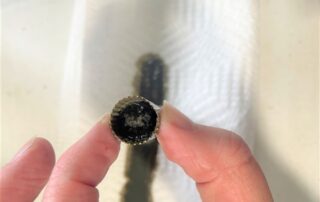
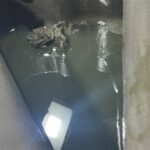
In Part 1 of this saga, our flying club’s newly installed O-360 lost oil pressure in flight with a student pilot at the controls. After a brief landing then an immediate a go-around (you read that right), and a fair amount of sweat and tears – but fortunately no blood – we found the engine had digested an errant paper towel, which was blocking the suction screen.
Crud in the pan

The hard part begins

Now that we knew the engine actually did suffer a loss of oil pressure (it wasn’t just the gauge) and the filter analysis showed that some damage had been done, our next step was to figure how to proceed.

We consulted as many experts as we could and received suggestions ranging from “just go fly it” to “pull a cylinder and look for damage” to “overhaul it” and everything in between. The jury was out, and we had to decide whose suggestion to follow.

Lycoming has a convenient Service Bulletin about what to do if you find metal in the oil filter, so we started there. Service Bulletin 480F suggested, based on the amount and size of metal in the oil filter, that we remove the oil pan and check for metal. That seemed like a good idea; not only were we still troubleshooting mechanical wear, but also, we didn’t know how much paper towel was still in the engine.

It took two solid days of work to remove, inspect, clean, and reinstall the oil sump, which still had paper towel in it. Once that was done, after finding no large pieces of metal in the sump and being sure there weren’t any leftover paper towels in the engine, we did a 30-minute ground run then drained the oil, and cut the filter to check for metal.

Intestinal fortitude

The oil analysis was unremarkable, but the oil filter report noted 10-15 non-ferrous metallic flakes per pleat with a few dozen larger pieces that had scrape marks on them. So – a little better than
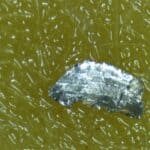
Metal from the filter, magnified in analysis

before, but certainly not clean. But this was only a 30-minute ground run compared to the 20-some hour sample. Were the improvements from the shorter oil change, or an actual improvement? We didn’t know.

Now, I’ve been an analyst at Blackstone for over a decade. I’ve helped countless customers diagnose their own engine issues and told people to go fly it and check back. But there isn’t any amount of intestinal fortitude that prepares someone for the reality of experiencing a problem, diagnosing engine damage, doing what you can to fix it, and know that the next step is to go flying and see how it goes.

The two A&Ps on the field agreed that if we made it past the first 10 hours (if) without any oil pressure issues, then we should be fine. “But watch that oil pressure,” they cautioned.

Going up

We took all the precautions we could: we went up in pairs (so one person could watch the oil pressure), we selected calm days, affording us four runway options for an emergency landing, and we stayed within glide distance of the airport for 10 long hours.

I am glad to say that those first 10 hours were uneventful. Oil pressure remained strong, the engine ran great, and we had no issues. With each hour that passed, our confidence grew, so we eagerly sent another oil and filter sample for analysis, hoping for hard data to bolster our confidence.

The oil analysis was unremarkable, but the filter – not great. Approximately 30 variously sized non-ferrous flakes were present per pleat, along with one piece of steel.

Not what you want to see

This wasn’t what we were hoping for, but this oil run was 10 hours long as opposed to the previous 30-minute ground-run sample. There was bound to be more metal, right? Regardless, there was still more metal after 10 hours than there was in our previous 50-hour samples, so we weren’t in the clear yet.

Our solution? Do another 10-hour oil run for an apples-to-apples comparison. At this point, with 10 hours of uneventful flying under our belt, our confidence was starting to grow, so we ventured out a little from the airport environment. After 10 hours, we sent the oil and filter for analysis, fairly confident that this second sample would reveal the improvement that was bound to come.

Instead, we received the disheartening news that “the overall quantity and size of the non-ferrous flakes was similar to the previous filter.” Dang.

Hard discussions

We debated what to do next. Are we throwing money away on oil and filters when we might need an overhaul anyway? Do we keep wasting filters when the nationwide filter shortage might ground us anyway? Do we run 25 hours, despite not seeing an improvement in the metals?

We reconsidered an earlier suggestion to pull a cylinder and look for crank/bearing damage, but that might raise more questions than answers: what should a 1500-hour crank/bearing look like? How will we know if the damage is excessive without pulling all four cylinders and comparing? And at that point why not just overhaul?

Opinions varied among our club members. One thought we were overreacting and that a paper towel couldn’t cause engine damage. Others of us were more cautious, remembering how little metal our engine used to make in 50 hours. As a group, we exchanged some vibrant text conversations as we decided how to proceed.

With our concern about irreversible, ongoing damage, we opted to do another short 10-hour oil change to try and limit further damage and get another good comparison to gauge progress. I was afraid that if this sample didn’t come back cleaner, we’d start considering exploratory surgery and watch the summer tick by from the ground.

Baby steps

We knocked those 10 hours out in less than a week and had results early the following week. I jokingly told my coworker that I’d bribe him with beer if he gave us a good enough report that we wouldn’t have to ground the aircraft for the summer.
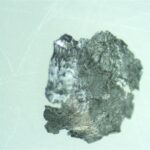
Still with the metal

As it turned out, no bribery was needed: the oil analysis came back clean and the filter report contained good news: less metal than before. Finally! Maybe everything was going to be okay. Granted, we’re not totally out of the woods yet – we’re still monitoring and we’re going to change the oil in 25 hours, but at least we’ve got data that suggests we’re past the worst of it. If the numbers are good in 25 hours, then we’ll try 50. That night of the improved report was the best night’s sleep I’d gotten in months.

Lessons learned

Hindsight is always 20/20, as they say, but looking back I think there are several lessons to be learned.

First, when you’re troubleshooting a problem, do your research and get as much data as you can. It honestly shocked me how many different opinions we received. At one point I called Lycoming. They called me back several days later, and after listening to my story the tech said we needed an overhaul.

I replied, “Well in the week I was waiting for you to get back to me, we did a 30-minute ground run, tested the oil and filter, and we’ve since flown a couple of uneventful hours, as per SB 480 and we’re planning on flying a total of 10 hours before retesting.”

He said, “Okay, that’s good. Do that and proceed as planned.”

In less than five minutes he went from telling me to overhaul to “go fly.” There’s a vast dichotomy there. I get that there’s a lot of liability in aviation, but that just makes it harder to make good, educated decisions. We did a lot of research, gathered data, and consulted with as many people as we could to make the best decision for us. Do your homework.

Second, remember that you have many tools in your toolbox for diagnosing problems. Our oil reports came back clean all along – it was the filter analysis that was showing metal. Oil analysis measures the microscopic particles in the oil; the filter/screen is where you’ll see visible metal. Always cut your filter open, and use oil analysis in conjunction with other tests (like borescope and compression checks). The more data you have, the better decision you can make.

Third, as we said last time – trust your gut. If your intuition tells you something is wrong, don’t ignore it. But the reverse is also true: after all those hours of flying the pattern with strong oil pressure, good RPMs, and normal oil temps, we had a strong feeling that our engine was going to be okay – we just had to wait a few oil changes for the data to support our intuition.

And last but certainly not least – keep the damn paper towels far away from your engine!

By |2026-06-05T16:12:54-04:00July 18, 2023|Aircraft, Articles|Comments Off on Under Pressure! (Part 2)

Pre-Buy Samples: The Art of the (Craigslist) Deal

Taking a sample before buying a new plane or boat is common practice in the aviation and marine industries, and it’s just as useful for anyone looking for their next car, truck, or motorcycle. If you’re anything like us, you probably spend an unhealthy amount of time browsing the local classifieds and Craigslist hunting for the elusive bargain. And although oil analysis can’t stop you from making a wire transfer to your new foreign royalty business associate, it can help you avoid buying a total lemon, and maybe even calm your nerves on the initial drive home.

Pulling a sample before plunking down the dough is a good move. We’ll test the oil for excessive amounts of metal, contamination, and solids. We compare your results to our database of samples from similar makes/models, giving you a good look at how internal parts are getting along, and if there are any looming problems driving the current owner to sell you their beloved ride. We’re familiar with common problems for certain engine models and years, and we know how different issues look in analysis.

It can be tricky to gauge whether excess metals are from poor wear or from how the engine has been used, especially if you don’t know how long the oil has been run. But even if the oil was recently changed, we can still often see evidence of serious problems. Maybe coolant has just started getting into the oil, but there’s not yet enough to give the oil that telltale milkshake appearance. It takes a pretty bad internal coolant leak to cause a visual change to the oil, but it doesn’t take much coolant to show up in analysis.

You’ll also learn the oil’s viscosity range, which can show if the current owner was using the correct grade. Analysis will also pick up on things like dirt from an intake leak or excess fuel from an injector issue. We always point out any potential problems in the report comments, and try to provide possible reasons for abnormal findings in the comments to help you make sense of the results.

Sampling

Most private owners and dealerships will allow you to collect a sample, at least with a bit of persuasion. The current owner has a vested interest in the health of their vehicle, and offering a copy of a report might help even if you don’t go through with the purchase.

We sell a vacuum https://www.blackstone-labs.com/products/vacuum-pump/pump so you can take a sample through the dipstick right then and there, while you’re looking at the vehicle. Samples can also be taken by loosening the oil filter or drain plug enough for some oil to drain out — just be sure to clean the area around the sample collection point if you go this route. If a seller refuses to let you collect a sample without good reason, that alone might be the red flag that sends you running.

Getting results in a hurry

We know you’re working on a tight schedule to make the deal happen, so if you don’t have a kit on hand when you go to look at your new ride, don’t fret. You can send the oil in any clean, plastic container with a screw-on lid. Just be sure to collect enough oil for testing (about 100 mL or 3 ounces, which is a little less than half a cup), and package the sample appropriately so it doesn’t leak in transit. The same information slips included in the kits can be found on our website. We appreciate all the info we can get about a sample, as it helps make sense of the results so we can provide the best possible report in return.

Buying a used vehicle can be an adventure, and we’re here to help you make the most informed decision possible!

By |2026-06-05T16:13:38-04:00July 13, 2023|Articles, Gas/Diesel Engine, Marine|Comments Off on Pre-Buy Samples: The Art of the (Craigslist) Deal

What is a Flashpoint?

We use the flashpoint test to determine how much fuel dilution is present in your oil. Technically speaking, the flashpoint is the lowest temperature at which a liquid will generate sufficient vapor to flash (ignite) when exposed to a source of ignition or fire. In other words, at what temperature do the vapors coming off your oil catch fire? For most gasoline oil samples, it’s around 380°F. For most diesel samples, it’s about 410°F.

Each brand/type of oil has an expected “should be” value for the flashpoint, and when the lab test results read lower than that value, it shows a contaminant in the oil. Most often that contaminant is fuel, though other things can affect the flashpoint too, such as solvents (like engine cleaner additives) or water. We calculate the amount of fuel present based on where the flashpoint is relative to the “should be” value and the volatility of the type of fuel you’re using in the engine. Alternative fuels like B20 can have a different impact on the flashpoint than standard fuels, so be sure to let us know if you’re using anything other than standard gas/diesel as fuel in your engine.

Based on the margin of error for the methodology we use for measuring the flashpoint, the lowest fuel dilution value you’ll see on one of our reports is <0.5%. That’s our way of essentially saying that no measurable fuel dilution was detected in the oil. If the flashpoint of your sample reads the same as the “should be” value, we’ll report a “TR” (or trace) of fuel dilution. In other words, it’s likely there was a very small amount of fuel dilution present, but not enough to quantify. After that, you’ll see fuel dilution reported as a percentage of the sample. The most fuel our test can accurately read is 10%. If you have more than that, we’ll report >10% (and you should head to a mechanic).

How much fuel is too much? It depends. We have different allowances for different types of engines based on their typical operational conditions, and we share those values in the “should be” column. If you’re constantly exceeding those values, you might consider the type of operation the engine sees just before sampling. Are you idling the engine to warm it up? Have you just been running errands around town? Is the dealer changing your oil (and starting your engine briefly to pull the vehicle onto a lift)? That type of operation can introduce a little fuel dilution into the oil and as such isn’t necessarily a concern. If the amount of fuel in the oil is consistently above 2.0-3.0%, or if it’s increasing from sample to sample, that might indicate a more serious problem.

A little fuel dilution – the type you’d get in your oil from operational factors — will cook out of the oil once the oil reaches operational temperature. If there’s a fuel dilution problem, though, you’ll see telltale signs: a rising oil level, high fuel dilution readings in testing, a strong fuel smell to the oil, and possibly low viscosity readings and increasing wear as well. The concern with excessive fuel dilution is that it dilutes and thins the oil, which might limit the oil’s ability to effectively protect and cool your engine.

By |2026-06-05T16:14:36-04:00July 13, 2023|Articles, Lab Tests|Comments Off on What is a Flashpoint?

What are Insolubles?

The insolubles test measures the total insoluble materials in an oil sample — that is, all solid or liquid materials that are not soluble (won’t mix) in with the oil. We test insolubles using the centrifuge method. A measured volume of oil is mixed with a heated solvent, agitated, and spun at high speed. Insoluble materials collect at the bottom of a tapered glass test tube and can then be quantified. The insolubles level indicates how fast the oil is oxidizing and how effectively the oil filtration system is functioning.

Virgin oils shouldn’t have more than a trace of insolubles in them. The insolubles in virgin oils are from the normal oxidation process of the oil, which leaves free carbon in suspension when oxygen forms with hydrogen (oil is a hydrocarbon). Or they can be from additives that have fallen out of suspension.

Industrial oil normally contains a very low level of insolubles due to the few and relatively mild heat cycles the oil experiences (heat cycles accelerate the oil’s normal tendency to oxidize). Further, oil filtration on industrial machines may filter particles as small as 2 to 10 microns, keeping the oil pristine for a very long time, often years.

Automotive and aircraft oils however, suffer the most difficult environmental problems of all types of oils we analyze. They regularly receive blow-by products from the combustion process, and they suffer extreme heat cycles. Any contaminant will accelerate the oxidation process, causing insoluble materials to increase. Because excessive solid material in the oil limits the oil’s ability to lubricate effectively, an engine oil with a high level of insoluble material needs to be changed.

Excessive insolubles can form if the oil or engine is running hot, is receiving more than a normal amount of contamination or blow-by, is suffering more (or more severe) heat cycles than is normal, is being run longer than a typical use cycle, or, on the other side of the coin, if oil filtration is marginal or relatively ineffective.

If we found no contamination in your oil and your oil change intervals are normal, we often mention a problem at oil filtration as a possible cause of higher insolubles. Your oil filter may be inferior, or it is possible the oil filter bypass valve has relieved if the filter is becoming restricted. The filter system bypass may also open upon unusually cold starts when the oil is too thick to pass through the filter media. Once the bypass relieves, the filter is effectively out of the system.

The insolubles test is a fair measure of several possible problems in your engine. One high reading needn’t be a cause of concern. Several high readings in a row merit investigation of what the problem may be.

By |2026-06-05T16:14:56-04:00July 13, 2023|Articles, Lab Tests|Comments Off on What are Insolubles?
Go to Top