



This Ain’t Your Daddy’s ATF
It’s been a while since we wrote about transmissions: how they work, the differences between manual and automatic transmissions, and what transmission oil looks like. Since that time, a fair amount has changed in the transmission world, both in the machines themselves and the oil they use, as well as our knowledge on the subject. “Lifetime” transmission fluids are pretty common now, as are CVT (continuously variable transmission) units. Transmission oil has changed too, with certain transmissions requiring special oils, so we thought it was high time for an update.
Learning how newer transmissions work
While manual transmissions are fairly simple machines that tend to run forever, automatic and CVT transmissions are more mysterious in how they work.
When we hire new report writers, training them on the ins and outs of transmissions and transmission oil takes quite a bit of time and a lot of internet searching to find good videos on how they work.
From time to time, a little “hands-on” training is required. Over the years we have purchased several different junk-yard transmissions and torn them down, looking to see how they work and where the metals we see might be coming from.
Dissections like this tend to be a lot of fun and we learn quite a bit from the process. They are also low-stress affairs because we don’t have to worry about putting anything back together.
One of the first transmissions we took apart was a classic GM Turbo-Hydramatic, which was used in GM cars and trucks from the 1960s to 1990s (see Figure 1).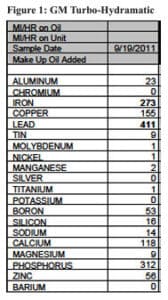 It was always a bit of a mystery as to where lead came from in that type of transmission and it turns out, it’s a bearing metal, just like what used to be common in engines.
Nowadays, aluminum is the bearing metal of choice for most engines and transmissions, and that makes our lives a little harder when writing reports because aluminum can be from other areas too.
Shaking up the world of transmission oil
For years and years, automatic transmissions like this didn’t have any special oil requirements. They all pretty much ran on Mercon/Dexron ATF (automatic transmission fluid). This is a light oil (normally 10W) containing only a little boron, calcium, and phosphorus as additive. It was also traditionally dyed red, so when it started leaking you knew where it was from.
Then in the early ’90s, Chrysler came out with ATF+3 and this shook everything up in the transmission world. This oil is still a 10W in viscosity and still has a red dye, but the oil additives were significantly different than anything we’d seen before (or since) — see Figure 2. 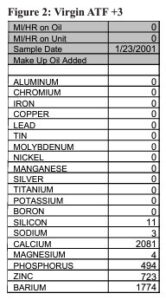
This oil and the transmissions they were used in worked just fine; problems only came about when a different type of ATF was added by mistake. This caused the transmission to burn up because the new oil’s additive package wasn’t correct. We started getting a lot of calls about this type of transmission where the mechanic thought someone added engine oil to it, but it was actually ATF that had just turned brown due to excess heat. So this problem has been around for a while, but for the longest time it was limited to Chrysler products — until CVT transmissions hit the market.
CVT transmission & oil
This type of transmission is also known as a shiftless transmission and is similar to what you might find on a snowmobile. It has a steel belt connecting two sets of cones. Both cones can change their diameter, which essentially allows the unit to have an infinite amount of “gear ratios” available.
We dissected one of these a few years back (see Figure 3) to see what made them tick. These units tend to work well but are extremely sensitive to the oil they use.
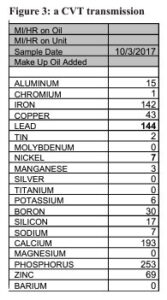 Again, most of these oils are light in viscosity (10W) but they have a unique additive package, and they also tend to be dyed blue or green to differentiate them from the typical red ATF that many transmissions run. Unfortunately, we see a lot of samples from CVT transmissions where the wrong oil has been used. This causes the units to burn up because the belt driving the cones relies on the oil’s additives to maintain the correct friction.
“Lifetime” transmission oil
The early 2000s brought about the rise of “lifetime” transmission fluids and also sparked a lot of debate about what that meant and how it could even be possible.
The idea that there is a fluid in your vehicle that never needs to be changed goes again some people’s religion, and I’ll admit it was a little difficult to understand at first. My 2003 Volkswagen Passat had that type of transmission, and it didn’t even have a dipstick, so I couldn’t run any tests on it to verify that the fluid was in good condition. Still, the lifetime of that transmission for me was 91,000 miles (that’s when I sold the car) and I will admit I never had any problem with it.
Still, it just seems wrong not to change the transmission fluid every now and then. Up until that point, I had always changed the transmission fluid in my cars and trucks, but after a lot of thought on the subject, I’m starting to wonder if that’s really necessary. For a lot of vehicles, changing the transmission oil could cause more problems than it could help, due to the possibility of the wrong oil being used to refill it.
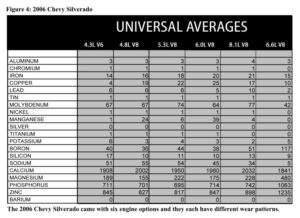
Also, it’s quite possible that the wear accumulation in transmission oil doesn’t have the same abrasive affect that it does in engines. To demonstrate this, I’d like to show you the first sample from my 1984 Chevy Custom Deluxe K20 pickup truck (see Figure 4). You might remember this truck from such classic newsletters as “Rebuilding a GM 350”, “ZDDWhat?”, and “The Renuzit Experiment.”
When I first bought this truck in 1999, I took a sample from the transmission and was sickened by the amount of metal that was present (see B30211). I immediately changed the oil several times myself and then got in the habit of having a shop change it every year or so. Still I expected that thing to give up the ghost at any moment and just hoped I wasn’t far out of town when it happened. The funny things is, it’s still running to this very day (and is still going as of June 2024).
Now maybe all of the oil changes that I did early on made that possible, but at this point I’m leaning towards another explanation: transmissions can make a lot of metal and still be perfectly normal. 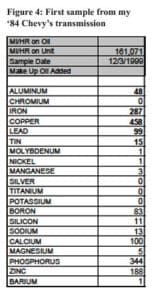
I think that’s because the oil in transmissions has a significantly different life than engine oil does. Transmission oils are mainly used as a hydraulic fluid to shift the gears though an ingenious invention called the valve body. This is like a circuit board that uses oil rather than electricity, and apparently the cleanliness of the oil doesn’t affect its operation.
Sure the oil also lubricates the gears, but as far as an oil’s jobs go, that’s one of the easiest things for it to do. The oil really doesn’t even have to be very clean to do that job well. So if the cleanliness of the oil isn’t that critical, then lifetime transmission oils start to make sense.
The transmission killer extraordinaire
It has been our experience that what kills most transmissions is heat. If the oil gets too hot it actually loses its viscosity and is no longer able to lubricate properly, which in turn causes more heat and eventually a total failure.
So in closing, if you have a “lifetime transmission oil,” rest easy — there is probably no need to worry about changing it. You’ll likely get sick of looking at the vehicle before the tranny dies. However, if you notice your transmission starting to leak oil, that’s the time you’ll want to have it fixed because its lifetime will quickly expire if you don’t. Just be sure they put the right oil back in!









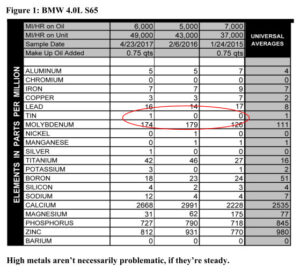
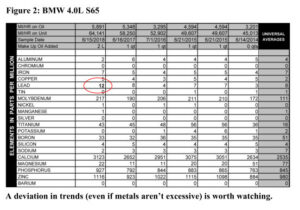 If you have them, trends are the most helpful thing we look at in determining your engine’s health. It takes three samples to get a good trend going (though we can often tell if something is amiss earlier than that).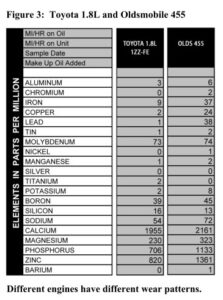
 If we don’t know what kind of engine you have, we might end up comparing your numbers to the wrong set of averages, or just a generic engine file. We can still tell if something is way out of line, but the more subtle differences between your engine and averages are harder to see.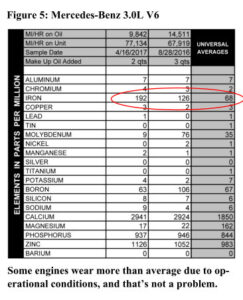



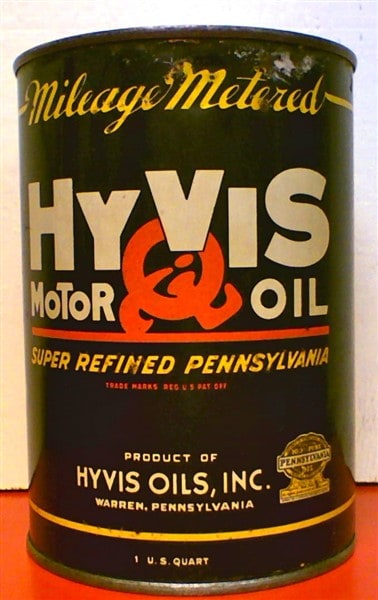 HyVis 4 Winter
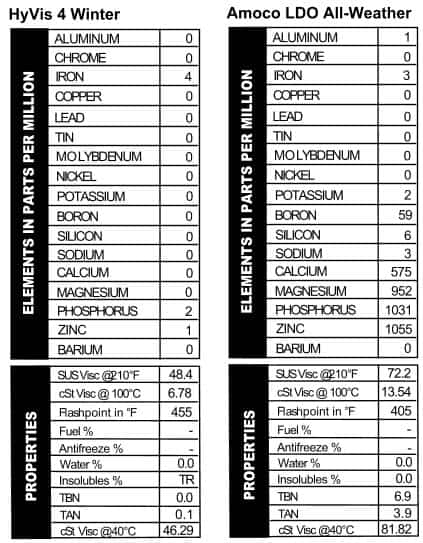 additive in it, just not any that we read. The grade is not listed on the can, but the viscosity came back as a light 20W. With the lack of additive it’s not surprising that the TBN read 0.0. It’s tempting to do an experiment and run this apparent mineral oil for 10,000 miles in the dead of winter, just to see what would happen. If you know of any guinea pigs, send them our way!
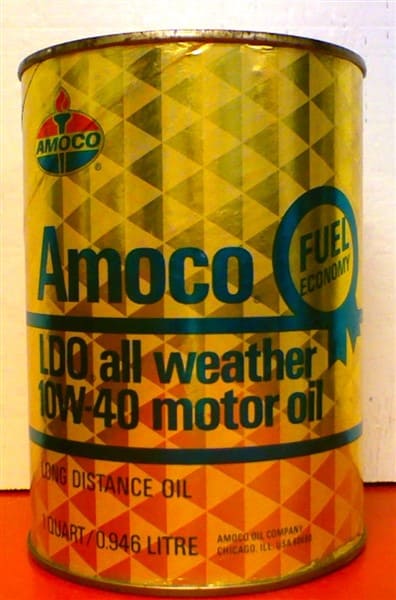 the country, and I’ll always associate the blue, red, and white logo with long trips across the country in our green van with the velour bed and hanging beads. But Amoco did more than fill up gas tanks in the 70s–they also sold oil, and this “Long Distance” version is an SAE 10W/40. The additive package looks a lot like the Mobil Special oil we saw: heavy on phosphorus and zinc, lighter on calcium and magnesium (Figure 2). Just the right oil for a couple of bandana-wearing hippies traveling with two little kids from Indiana to Nova Scotia in 1976 in a green van with a sunset painted on the side. Ah, the ’70s.
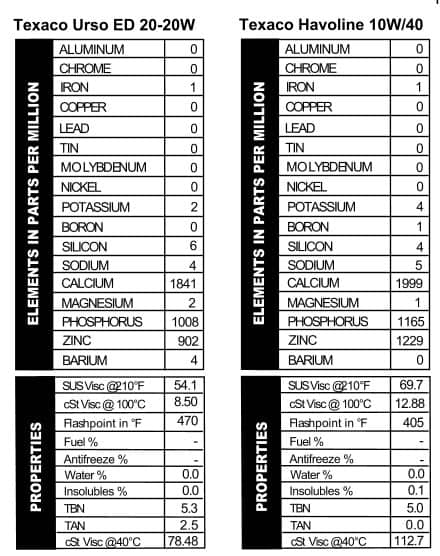 The viscosity read like what we see today out of a standard 5W/30. Texaco Havoline Super Premium 10W/40, on the other hand, looks a lot like one of today’s diesel-use oils in additives (Figure 4), with a normal 10W/40 viscosity.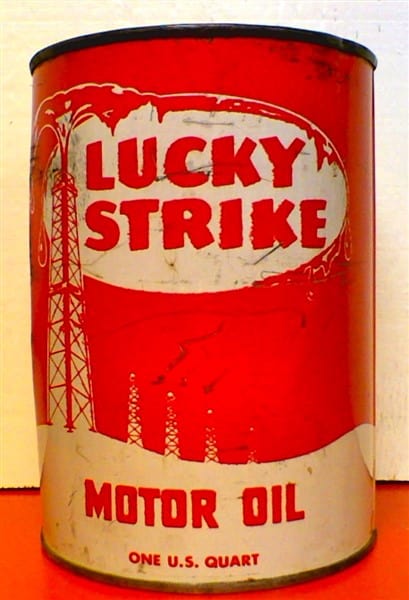
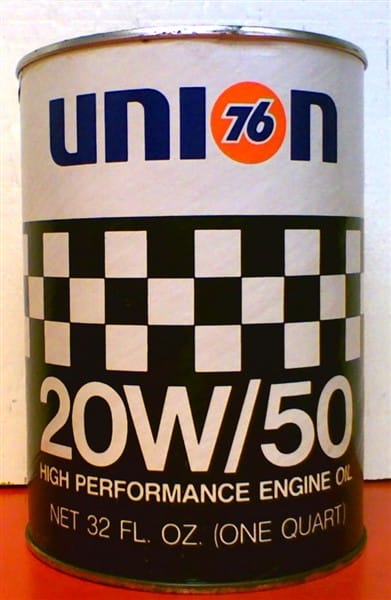 only did they not make multi-viscosity oils that long ago, but the can comes from zip code 90017 so it has to be from 1963 or later. According to the can, it’s 100% parrafinic oil with selected additives, which our spectrometer reveals to be your standard line-up of calcium, phosphorus, and zinc (Figure 6). Look at that viscosity though¾it’s higher than we see in today’s 20W/50s.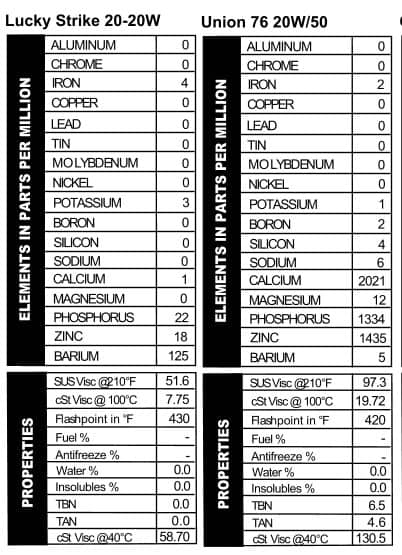
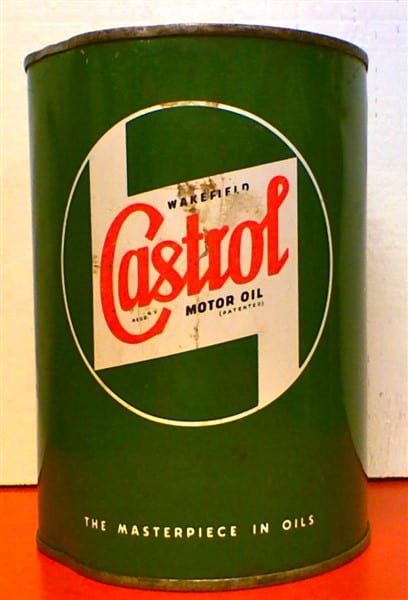 Like modern oils, they stress the high quality of the oil with terms like “organo-metallic” that are meant impress those of us who aren’t in the oil business. I don’t know if I’d call this a masterpiece in oil work though: it looks like what we see out of ATFs these days as far as additives go (mostly phosphorus with a little zinc thrown in). Since the word “Racing” is stamped into the top of the can, the thick viscosity (like a 50W) makes sense (Figure 7).
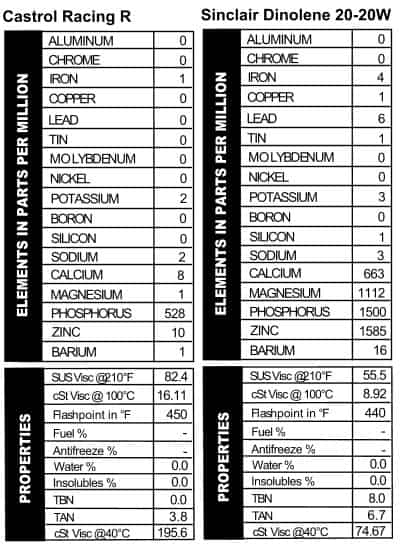 I’ve always had a soft spot in my heart for Sinclair. The can has a picture of a dinosaur on it! This shit came from the ground, no doubt about it! Another 20-20W oil, the oil is light on advertising copy but heavy on additives. In fact, it looks a lot like recent versions of Shell’s Rotella 5W/40, except with a little less calcium. It’s much lighter than Shell’s 5W/40, though, with a viscosity reading like a 30W or a heavy 20W oil. Note the presence of lead (Figure 8).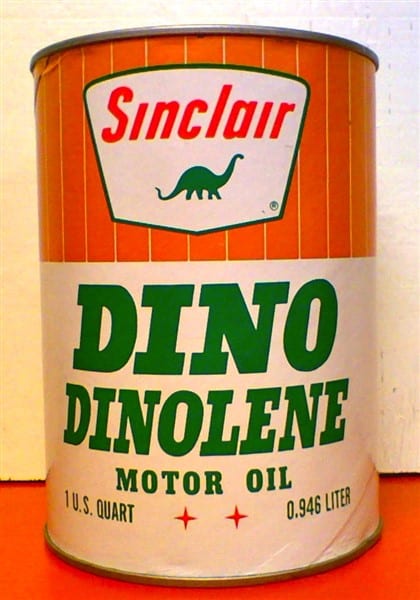
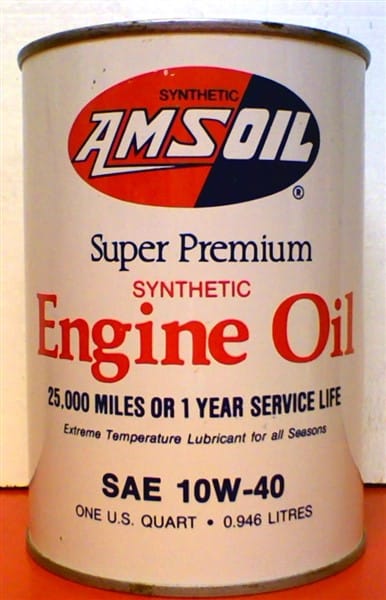 Modern Amsoil products tend to be heavy on additives and that was true back in the day as well (Figure 9). Just for fun, we compared this oil with a virgin sample of Amsoil 10W/40 that we ran in February 2012 and they look a lot alike. The only difference is in the older oil there’s less of everything: 500 ppm less calcium, and 100-200 ppm less phosphorus and zinc. They used magnesium in the older oil, while the TBN and viscosities were nearly identical.
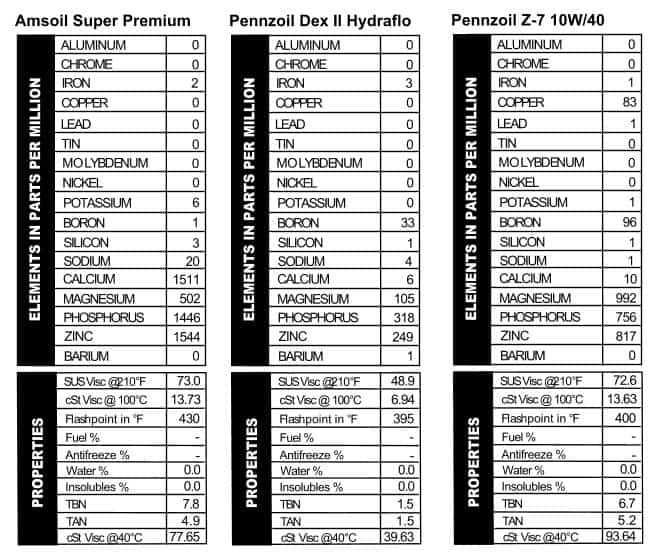 over these two old cans. Originally, Penn’s Oil came from an oil field in Pennsylvania and was christened with a Liberty Bell logo to remind users of its Pennsylvania roots. This can of ATF clearly has an earlier generation of logo on it, and Google informs me that Dexron II was introduced in 1972. This may very well have been the transmission oil that kept our green van chugging through the ’70s. There are a lot of different ATFs in stores today, though generally they have about the same additive configurations. This one is a little different in that it has more boron, magnesium, and zinc than most modern ATFs. The viscosity is right where we’d expect it to be though. Pennzoil’s 10W/40 oil can is flashy, a la the
 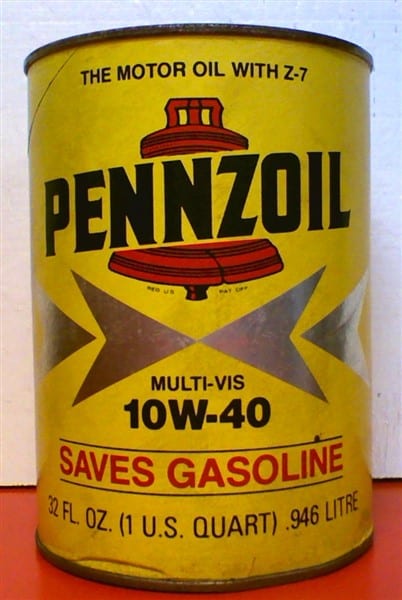 1980s. It’s “The Motor Oil With Z-7” and although they don’t specify what that is, they do specify that “You need no extra oil additive.” So that’s reassuring. It’s rated SF-SC-CC, so I’d place it at about 25 years old. Maybe the magic of Z-7 is copper: that’s something we saw a lot of back in the day, when Blackstone was founded. Interestingly, magnesium is the dominant additive in this one, followed by zinc, phosphorus, copper, and boron (Figure 10). The flashpoint was lower than what we see today from 10W/40s.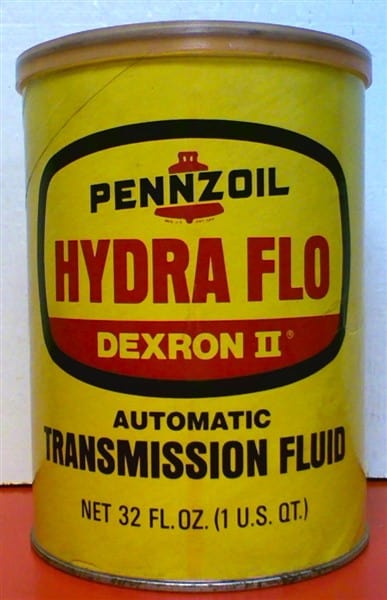
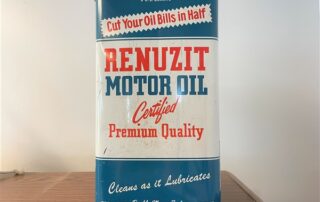
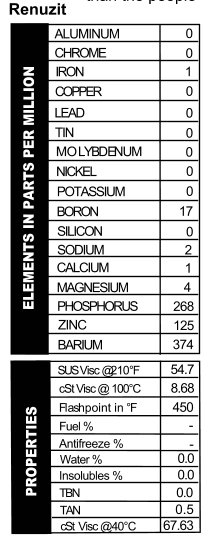 a can like the others. This one was sold in a 5-quart metal jug. I particularly love this one, because the can not only says you’ll “Cut Your Oil Bills In Half,” but the first point of advertising on the side is a “Faster Getaway!” Now, they don’t actually say that this is the choice of oils for bank robbers, but I know if it was 1941 and my hungry Great Depression self was contemplating which oil to put in my Ford Special for bank-robbing time, this is the oil I’d pick. With practically no calcium or magnesium present, the oil’s TBN read 0.0, but it does provide would-be crooks with phosphorus, zinc, and barium as well as a 20W viscosity for the getaway (Figure 11). When you’re busy working a tommy gun, the last think you want to think about is whether or not you’ve made the right choice in oil.