

Particle Count Test

The ISO Code (also known as the particle count test) is a system for representing particle concentrations in oil. The test is commonly referred to as the particle count. Without the use of the ISO Code, a confusing series of numbers would have to be examined to determine how clean an oil is.

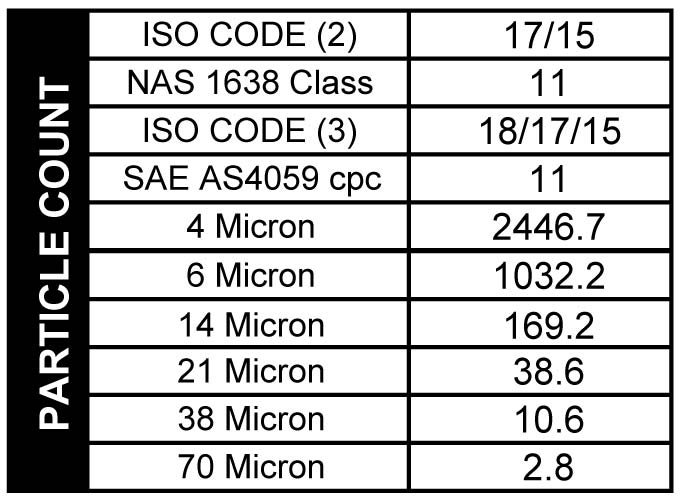
In oil laboratories, automatic particle counters determine the ISO code. Below is a particle count report for hydraulic oil.

The particles are counted in six different size ranges (see the sample Particle Count test results below). Every particle count test by Blackstone is reported in ISO 4406 (2- and 3-number codes), NAS 1638, and SAE AS4059 formats. The left column shows the size in microns. The right column is the number of particles per mL of sample that were found to be larger than each micron size. In the chart below, the number of particles larger than 14 microns in size was 169.2.

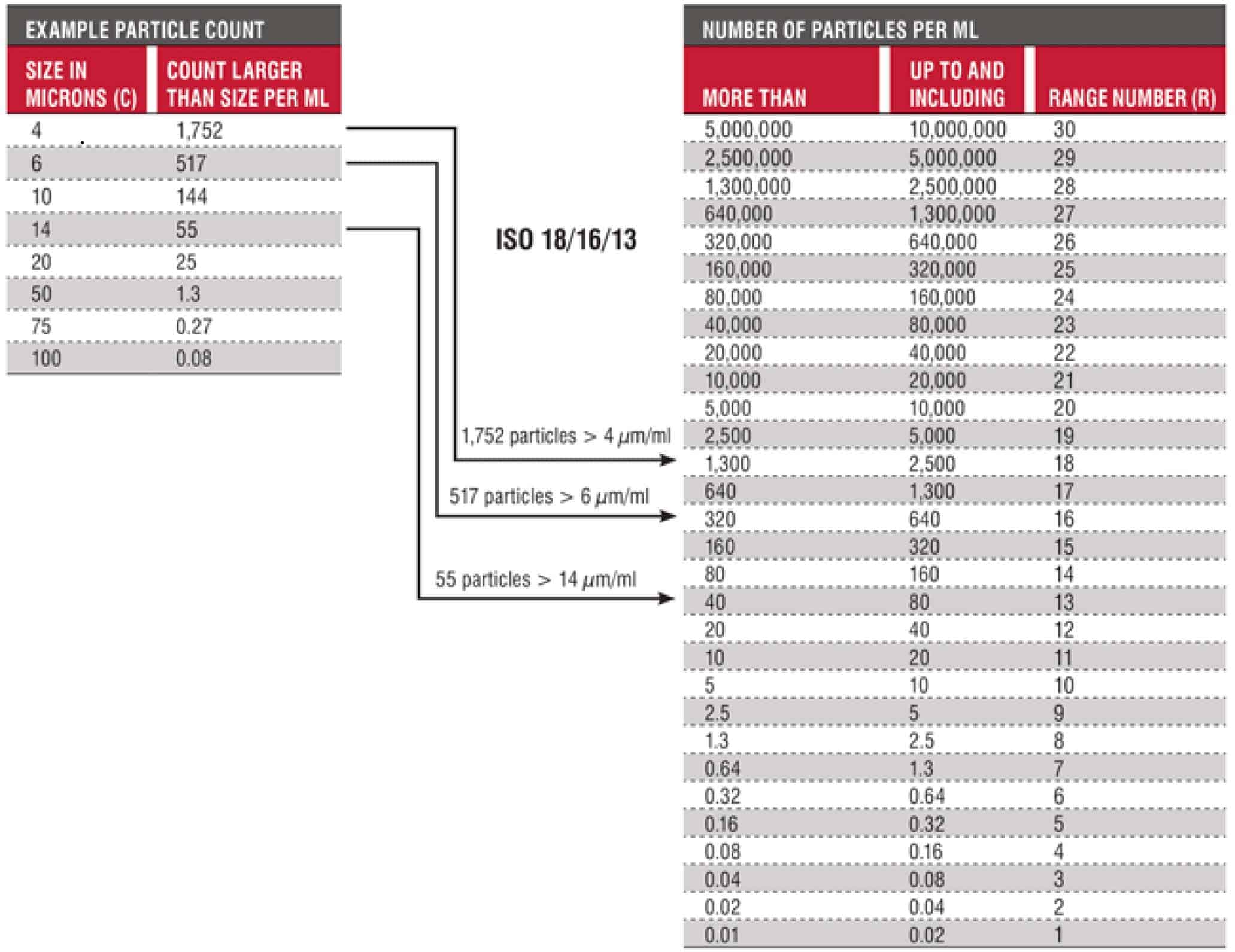
The ISO 3-number Code in this example is 18/17/15. These three numbers (18, 17, and 15) identify a range of particles counted in the size above 4, 6, and 14 microns, respectively.

The ISO 2-number code in this example is 17/15. Those two numbers (17 and 15) identify a range of particles counted in the size above 5 and 15 microns in size. The chart does not list the actual number of particles counted at 5 and 15 microns.

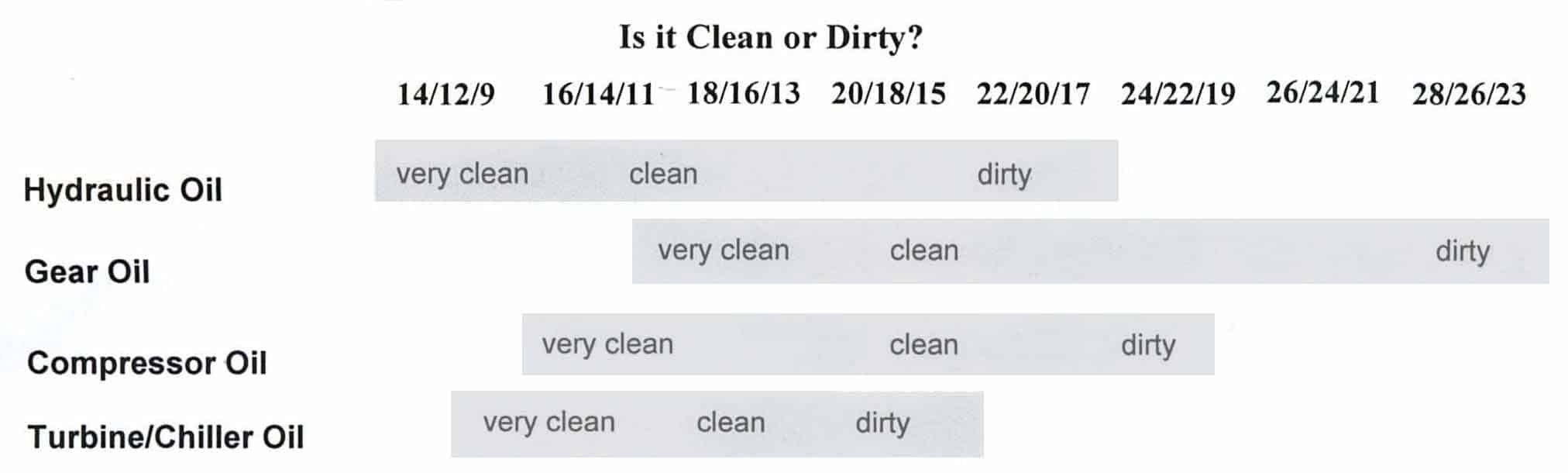
The higher the ISO Code, the dirtier the oil. However, different oils can have different allowances for what we deem “clean” or “dirty.” The chart below shows the clean to dirty ranges for four types of oil:

But wait! How do we arrive at the 18/17/15 or 17/15 range? Using this chart:

Confusing, right? That’s why we use the code. Most equipment manufacturers will list guidelines as to what cleanliness code is acceptable, and that’s all you need to know.

By |2026-06-05T16:15:07-04:00July 13, 2023|Articles, Industrial, Lab Tests|Comments Off on Particle Count Test

Industrial Oil Analysis

Industrial machinery literally runs on oil, and that oil needs to be maintained. Oil that becomes wet, acidic, or abrasive will turn on its host (machine) and become a liability. Oil analysis can help.

Maintenance programs, when in place at all, have historically depended on a time-based change program (often at an annual shutdown). While this is better than nothing, with time-based intervals, you have no idea whether the oil actually needs to be changed or not. Changing the oil is time consuming and if you’re throwing away good oil, you’re tossing money down the drain, hurting the bottom line. 

Through analysis, you can monitor the condition of your oil to ensure the oil change interval is correct, and you can also monitor the health of machines, scheduling inspections and repairs during planned down-times instead of waiting for mechanical failures.

Moisture problems

Industrial oils run “cold” compared to other (such as automotive-use) oils, and they tend to accumulate moisture. The moisture comes from humidity in the air, or in some cases, it’s directly introduced to the oil from coolants and related systems. Moisture affects the lubricity of the oil, decreasing its effectiveness. Moisture in the oil can cause a variety of problems, such as poorly running hydraulic rams, machine seizing, and chatter.

Another negative effect of moisture in oil is acidity. Oil, by its molecular nature, cannot become an acid. But there is always a little moisture present in oil that’s operating at relatively cool temperatures, and that moisture can turn acidic. Acids in a machine’s oil sump will corrosively attack internal parts — not only the metallic parts, but the seals as well. Corroded valves become ineffective. Many headaches in a machine’s operation can be directly attributed to oil condition. Though oils do not respond to the pH test, there is a neutralization test called Total Acid Number (TAN) that can easily spot oil that is becoming problematic.

Abrasion problems

Industrial oil becomes abrasive from wear metals, abrasive dirt, and particle contamination. Too much metal in the oil can make the oil itself abrasive, causing a snowball effect in wear or seal degradation. Machine seals are lubricated by the system’s oil, and they will last a long time if the oil is maintained effectively. If not, the seals will degrade and cause leakage. Leaking machines require pans under them, which need to be vacuumed regularly, and the waste oil poses a disposal problem. Fresh oil is purchased needlessly, running up maintenance costs. Machines that leak also run the risk of being run low on oil and having improper oils used as replacement. All these expensive problems can be eliminated by keeping the oil in serviceable condition.

What about filtering the oil?

Many industrial operations hire filtration companies to filter insolubles and abrasive contaminants from their oil. Some plants operate their own filtration equipment. Filtering oil that’s currently in use is a good idea, and it helps companies avoid needlessly purchasing virgin oil products, but it has limits. Not everything can be removed by filtering the oil, and some filtration systems are less effective than others. Oil analysis can help determine which oils need filtering or changing and it can help determine the effectiveness of a company’s filtration program.

Not all wear metals and abrasive contaminants can be filtered out of the oil; they tend to accumulate and eventually reach levels that leave the oil unserviceable. A test known as the ISO Cleanliness Code (also called a “Particle Count“) can be used to rate the cleanliness of an oil sample. This test also shows the effectiveness of the machine’s in-line oil filtration.

Preventive maintenance

When a machine you depend on for your daily output fails, it costs far more than the cost of repairs; a company can lose millions in down time and lost production. When you think of it, the cost of a routine oil analysis for your machines may be the least expensive insurance you can buy to keep your machines mechanically healthy, well lubricated, and functioning trouble-free.

Need kits? Order yours today!

By |2026-06-05T16:15:17-04:00July 13, 2023|Articles, Industrial|Comments Off on Industrial Oil Analysis

The Silicon Question

In one of the early years of our business, we were visited by a gentleman from another laboratory. I remember him standing in our lobby emphatically stating that the element silicon – when it appears in the spectrometry of oil – has one source and one source only: abrasive dirt.

He was wrong. Many people believe silicon only comes from dirt, but myriad sources of silicon exist. In oil analysis we look at elements rather than molecules, so silicone from harmless sealers and silicon (no “e”) from abrasive contaminants will both read as the elemental form of silicon. We use deductive reasoning to determine whether the silicon is abrasive or not, and sometimes the answer isn’t entirely clear just by looking at the data. In those cases we’ll cover all the bases and talk about the different sources of silicon and offer a variety of suggestions on how to proceed. Some forms of silicon will harm an engine, and others will not.

Harmless silicon

Silicone-based gasket sealers used in engine assembly and repair show up as high silicon in an oil sample. Any oil sample taken from a new, rebuilt, or repaired engine typically reads high in silicon. Oil from some types of new engines may contain as much as 400 ppm silicon. You can ignore the high silicon in these cases since it is harmless and will wash away by the third or fourth oil change.

Certain brands of engine oil and aftermarket oil additives contain silicon as an anti-foaming additive. The oils that use silicon as an additive can use up to 15 ppm of silicon or so, and we’ve seen silicon in aftermarket additives reading up to 850 ppm. It’s always important to let us know what oil brands and additives you’ve used so we can take that into consideration when writing your comments.

Your sampling procedure might introduce some silicon to the oil as well. The silicon might be from dirt around the drain plug or from a dirty collection pan if you’re dipping the sample out of the pan after you drain the oil. We’ve seen silicon read at several hundred ppm from using new plastic tubing or turkey basters to pump/collect samples. Silicon introduced in the sampling process is harmless to the engine internals.

Harmful silicon

Silicon can read high in an oil when coolant seeps into the oil system. It comes from silicon (rust) inhibitors used in the antifreeze. While the inhibitors aren’t necessarily harmful, the antifreeze certainly is, and you will want to seek repairs before the engine is seriously damaged.

Finally, there’s the abrasive form of silicon: dirt. Abrasive contamination causes poor wear in the cylinders, so if you see high silicon and poor cylinder wear, chances are good the silicon is abrasive. Check the air filter: Is it dirty? Installed properly? Check the seals and connections to make sure they’re properly sealed. Check the air box for rodent or insect nests, particularly if the engine hasn’t been started in a while. Look for cracks or leaks in the induction tubing. In aircraft engines, check the carb heat/alt air doors to ensure proper sealing.

Silicon has several possible sources in analysis. The more information we have about recent engine work, oil brands, aftermarket additives, and your sampling procedure, the easier it is for us to work with you to help determine whether the silicon is abrasive and what steps you should take to protect your engine. At Blackstone Laboratories, our analysts consider all these factors when making recommendations to help you prolong your engine’s life. In the end, that’s what it’s all about! 

By |2026-06-05T16:15:30-04:00July 12, 2023|Aircraft, Articles, Gas/Diesel Engine, Industrial, Lab Tests, Marine|Comments Off on The Silicon Question

Do I Need a TBN?

What is a TBN, and who uses it? In short, a TBN (Total Base Number) measures how much base (as in base vs. acid) additive is in the oil to offset the effects of acids coming into the oil from combustion and other sources. Scientifically speaking, the TBN is one of two “neutralization number” tests run on oils. The TAN (Total Acid Number), which is used for hydraulic and gear oil, is the other. The TBN test is useful for anyone who wants to extend their oil use beyond the normal range.

The oil’s function is to lubricate, clean, and cool the engine. Additives are added to the oil to enhance those functions. The TBN will start out reading in the 6.0 to 14.0 range (depending on the oil and whether it’s meant for gas or diesel engines). When you first start using the oil, the TBN tends to drop sharply. Then it levels out and drops more slowly after that. The lower the TBN reading, the less active additive the oil has left. A low TBN test result, meaning very little additive is left, is down around 1.0 or lower.  

The TBN is not the only factor to consider when determining how long an oil can be used. If wear accumulations and insolubles in the oil build up and become abrasive, we would recommend changing out the oil, no matter how high the TBN reading.

We offer a TBN test on any gasoline or diesel oil sample for an additional $10. Note: You do not need to send in a virgin sample for us to run a TBN on your oil. Some people like to know where the TBN starts out in virgin oil, and of course we’re happy to test that for you if you’d like. The cost of a virgin oil sample plus TBN is the same as a regular oil sample plus TBN.

By |2026-06-05T16:15:42-04:00July 12, 2023|Articles, Gas/Diesel Engine, Lab Tests, Marine|Comments Off on Do I Need a TBN?
Go to Top